



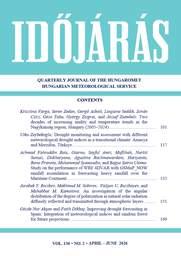
Vol. 130, No. 2 * Pages 101–224 * April - June 2026
 |
|
 download [pdf: 6371 KB]
Krisztina Varga, Seren Zedan, Gergő Asbolt, Loujaine Seddik, István Csízi, Géza Tuba, György Zsigrai, and József Zsembeli
DOI:10.28974/idojaras.2026.2.1 (pp. 101–115)
PDF (1904 KB) |
Abstract
To better understand the impacts of global and regional climate change, it is essential to conduct investigations at the local level as well, particularly in climatically sensitive areas. The aim of our study is to present the climatic characteristics of the Nagykunság region based on annual data recorded at the Karcag meteorological station (HungaroMet 55405) between 2005 and 2024. Our analysis focuses on the long-term trends of key meteorological variables such as temperature, precipitation, evaporation, sunshine duration, wind speed, and air pressure. For data processing, we used the built-in statistical tools of Microsoft Excel, especially linear regression, moving averages, and trendline fitting. During the examined period, we identified a significant increase in temperature (+0.097 °C/year), a slight decrease in precipitation (–9.72 mm/year), and a rise in the number of sunshine hours (+18.95 hours/year). Our results highlight not only the ongoing climatic changes but also the urgent need for regional adaptation measures, particularly in agricultural management and water resource planning. The methodology demonstrates that accessible statistical tools can provide valuable insights to support local climate resilience strategies.
Utku Zeybekoglu
DOI:10.28974/idojaras.2026.2.2 (pp. 117–134)
PDF (3302 KB) |
Abstract
The identification, monitoring and prediction of the possible future conditions of drought, a complex disaster, are of significance for decision makers in planning natural-social and human activities and planning, operation, and management of water resources. The present study investigates the meteorological drought experienced by Amasya and Merzifon, located within the transition zone between the Black Sea and continental climates in Türkiye. The analysis employs the standardized precipitation index (SPI), the China-Z index (CZI), and the modified China-Z index (MCZI), utilizing annual time scales to assess the precipitation patterns in these regions. The precipitation records obtained from the selected meteorological stations between 1964 and 2023 were analyzed in order to assess the drought and compare the performance of precipitation-based drought indices. The investigation also focused on drought-wet period percentages, the percentages of occurrence of drought classes, and the negative and positive peak index values. According to all three drought indices, significant dry years were identified, including 1964, 1974–1976, 1982, 1984, 1986, 1990, 1999, 2013, 2017, and 2020.The assessment revealed that SPI, CZI, and MCZI performance was similar in identifying drought in transition climate zones. It was also determined that CZI and MCZI are a viable alternative to SPI for drought monitoring.
Achmad Fahruddin Rais, Giarno, Sayful Amri, Muflihah, Nurtiti Sunusi, Didiharyono, Agustina Rachmawardani, Hariyanto, Bono Pranoto, Muhammad Syamsudin, and Bagus Satrio Utomo
DOI:10.28974/idojaras.2026.2.3 (pp. 135–150)
PDF (3790 KB) |
Abstract
This study evaluated the performance of the Weather Research and Forecasting (WRF) model with Four-Dimensional Variational (4DVar) data assimilation using the Global Satellite Mapping of Precipitation (GSMaP_NOW). Several verification metrics, including the root mean square error (RMSE), bias Score, equitable threat score (ETS), - fractional bias score (FBS), and fractional skill score (FSS) were employed in the assessment. The results demonstrated that 4DVar improved the accuracy of vertical velocity and specific humidity predictions at mid and upper levels, as well as the enhanced heavy rainfall forecasting. Spatially, 4DVar was able to increase specific humidity and vertical velocity in lowland areas, leading to higher rainfall in those regions. Future studies should investigate the assimilation of additional conventional and satellite observations to further enhance forecast accuracy.
Jurabek Y. Rozikov, Makhmud M. Sobirov, Valijon U. Ruziboyev, and Muhabbat M.Kamolova
DOI:10.28974/idojaras.2026.2.4 (pp. 151–167)
PDF (1697 KB) |
Abstract
This study investigates the angular distribution of the degree of polarization of diffusely reflected and transmitted natural solar radiation in atmospheric layers subjected to multiple Rayleigh scattering. The analysis employs the Chandrasekhar's S,T- matrix theory and the factorization method. Specific characteristics related to the numerical computation of X and Y functions using the successive approximations method are detailed. The results reveal that when the observation angle equals the illumination angle a notable feature emerges in the angular distribution of the degree of polarization of diffusely transmitted light. At this juncture, a sharp change in the degree of polarization is observed. Additionally, the study examines the dependence of the angular width of this discontinuity on the illumination angle and optical thickness.
Gözde Nur Akșan and Fatih Dikbaș
DOI:10.28974/idojaras.2026.2.5 (pp. 169–223)
PDF (7692 KB) |
Abstract
Drought is a serious environmental issue that negatively impacts water resources, agricultural production, ecosystems, and economic activities as a result of prolonged periods of low precipitation. In particular, the depletion of water resources and difficulties in accessing water pose significant threats to societies. In this context, developing effective forecasting systems in regions at risk of drought is critical for managing water resources more efficiently and taking timely measures. This study examines the potential of integrating various drought indices and machine learning techniques to improve the accuracy of meteorological drought predictions. Using data from 54 meteorological stations in Spain for the 1973–2023 period, drought analyses were conducted based on the standardized precipitation index (SPI), standardized precipitation evapotranspiration index (SPEI), and reconnaissance drought index (RDI). Future drought predictions were made using the Random Forest (RF) algorithm. The RF algorithm successfully analyzed historical climate data to understand the temporal and spatial dynamics of drought occurrences. Additionally, a newly developed drought mapping approach demonstrated that short-term droughts are more prevalent in northern Spain compared to the southern regions. The findings highlight the likelihood of increased drought severity in specific areas and its potential impacts on agricultural production and water management. This study serves as a crucial guide for policymakers aiming to develop drought management strategies and contributes to effective planning to mitigate future drought impacts. Furthermore, the developed software is provided as open source alongside the article.

Megrendelhető a journal.idojaras@met.hu címen.
A szerzőknek szánt útmutató itt olvasható.
